
Custom CPAP Mask Cushions Manufacturing
LSRParts manufactures custom CPAP mask cushions for OEMs, medical device companies and respiratory product developers that need production-ready silicone components built around their own drawings, fit requirements and validation plan.
We do not supply generic replacement cushions as off-the-shelf products. We support custom CPAP cushion programs from early DFM review and material selection through tooling, sampling, validation, mass production, inspection and packaging.
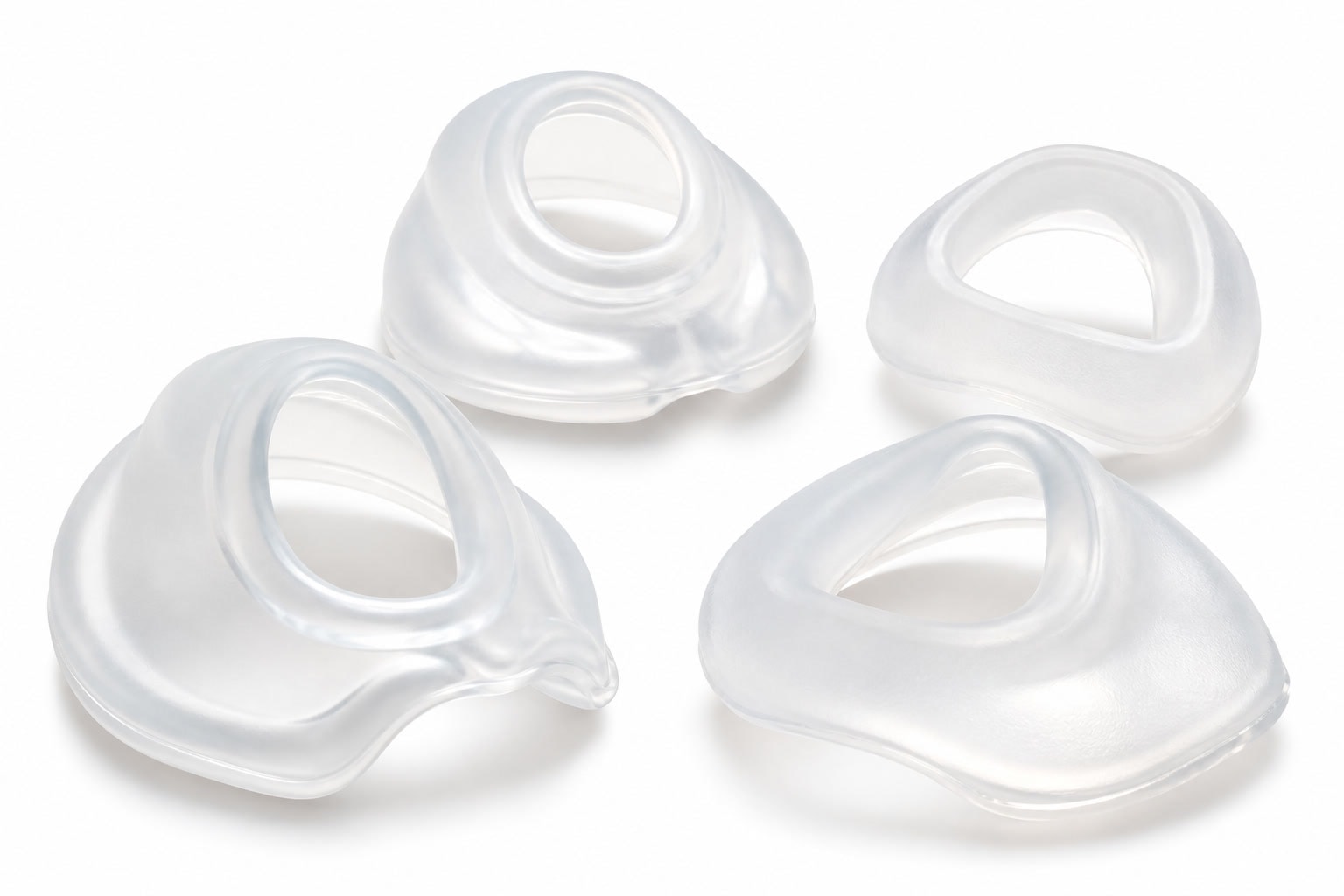
CPAP Mask Cushions Built Around Fit, Seal and Repeatability
A CPAP mask cushion has to do more than look correct in CAD. It must seal against the face, recover after compression, remain comfortable during extended wear and maintain dimensional consistency across production batches.
For customers, that means fewer fit-related failures, more predictable assembly, cleaner validation work and better control over long-term supply.
Skin Contact & Comfort
Soft skin-contact surfaces, stable sealing lips and thin-wall features designed for extended wear comfort.
Material Flexibility
Medical or skin-contact silicone material options with clear, translucent or custom-colored formulations.
Production Consistency
Consistent cushion geometry after demolding and post-curing with low-flash molding around sealing edges.
Precision Manufacturing
Production tooling designed for repeat annual demand with tight dimensional control batch after batch.
Quality Assurance
Secondary trimming, inspection and packaging services to deliver parts closer to final assembly condition.
Design Support
Early DFM review to identify molding risks before tooling begins and optimize part geometry for manufacturability.
Why OEMs Work With Us on CPAP Cushion Projects
A reliable cushion starts before the mold is built. We review the part geometry, sealing edge, wall thickness, draft, undercuts, expected compression behavior, flash sensitivity, shrinkage, tolerance and production volume before tooling begins.
This gives your engineering team a clearer path from prototype validation to mass production. Instead of discovering molding risks after the first tool trial, you receive DFM feedback early enough to adjust the design, select the right silicone hardness and define tooling requirements around the actual application.
Our Typical Project Flow
Manufacturing Capabilities for CPAP Mask Cushions
| Process | Liquid Silicone Rubber Injection Molding |
| Application Focus | Custom CPAP mask cushions, nasal cushions, full-face cushions, nasal pillows, respiratory seals |
| Maximum Part Envelope | 300 × 200 × 100 mm |
| Silicone Hardness | 10–80 Shore A |
| Typical Part Tolerance | ±0.05 mm |
| Critical Tolerance | Down to ±0.02 mm, application dependent |
| Mold Manufacturing Tolerance | ±0.01 mm |
| Part-to-Part Repeatability | Approx. ±0.1 mm, geometry dependent |
| Mold Cavities | Single-cavity / Multi-cavity |
| Production Mold Life | 3–5 million shots, tooling/application dependent |
| Mold Materials | P20 / H13 / 420 Stainless Steel |
| Tooling Type | Prototype Tooling / Production Tooling |
| Production Scale | Prototype to high-volume mass production |
| Color | Clear, translucent, custom color or Pantone matching |
| Surface | Matte, polished or custom texture |
| Automated Molding | Available |
| Secondary Operations | Post-curing, precision trimming, printing, laser marking, bonding, assembly, inspection, packaging |
Material Options for Respiratory Silicone Components
For CPAP mask cushions and related respiratory parts, material selection affects skin feel, compression set, tear resistance, durability, cleaning resistance and regulatory suitability. We help customers compare silicone options based on the intended use environment, validation requirements and production targets.
Medical Grade LSR
Skin-contact cushions, respiratory device seals, medical components
Platinum-Cured Silicone
Medical and skin-contact applications where clean curing chemistry is required
General Purpose LSR
Non-critical device components and industrial respiratory accessories
Optical LSR
Clear or light-transmitting components where optical clarity matters
High-Temperature Silicone
Parts exposed to elevated temperature during processing or use
Low-Temperature Silicone
Components used in cold storage or outdoor environments
Electrically Conductive Silicone
Respiratory electronics, sensors or EMI-related sealing needs
Custom Compounds
Application-specific hardness, color, performance or processing requirements
DFM Support Before Tooling
CPAP cushion tooling can be sensitive because sealing features are often thin, flexible and geometry-dependent. Small design choices can influence flash, part release, dimensional stability and sealing behavior.
During DFM review, we check:
- ✓ Sealing lip thickness and transition areas
- ✓ Cushion wall thickness balance
- ✓ Draft and demolding direction
- ✓ Undercuts and tool action requirements
- ✓ Flash control around patient-contact edges
- ✓ Parting line location
- ✓ Silicone hardness and compression behavior
- ✓ Shrinkage allowance
- ✓ Tolerance feasibility
- ✓ Expected production volume and cavity planning
- ✓ Trimming, post-curing and inspection requirements
The result is practical feedback your team can use before committing to tooling. That reduces redesign loops, avoids avoidable tool corrections and helps your project reach validation samples with fewer delays.
Tooling Capability Specification
Prototype to Mass Production Support
Many CPAP cushion projects start with a limited validation quantity, then move into repeat production after fit, seal and assembly requirements are confirmed. We support both stages.
For early-stage programs, prototype tooling helps your team test geometry, silicone hardness, user fit and assembly behavior before investing in production tooling. For approved programs, hardened steel multi-cavity tooling supports repeat production, better unit economics and stable supply.
Prototype Tooling Benefits
- ✓ Test cushion geometry before production tooling investment
- ✓ Validate silicone hardness and user fit early
- ✓ Make fit or sealing corrections before production mold
- ✓ Keep development schedules moving with 10–12 day lead times
Production Tooling Benefits
- ✓ Hardened steel multi-cavity tooling for repeat production
- ✓ Better unit economics at scale
- ✓ Stable supply with 3–5 million shot mold life
- ✓ Planned around forecast volume, cavity count, inspection needs
Fast prototype tooling helps your team evaluate cushion geometry earlier, make fit or sealing corrections before production tooling, and keep development schedules moving without waiting for a full production mold. When the design is approved, production tooling can be planned around forecast volume, cavity count, inspection needs and packaging requirements.
Secondary Operations and Inspection
CPAP mask cushions often need controlled finishing after molding. Flash, edge quality and cleanliness can directly affect comfort, sealing and assembly. We provide secondary operations to help deliver parts that are closer to final assembly condition.
Post-Curing
Precision Trimming
Die Cutting
Punching
X / Y Slitting
Valve Slitting
Pad Printing
Silk Screening
Laser Marking
Drilling
Bonding
Dipping
Cutting & Coiling
Assembly
Functional Testing
Inspection
Custom Packaging
Inspection plans can be aligned with your drawing requirements, critical dimensions, sealing features and production approval process. This helps your incoming quality team receive parts with clearer dimensional records and more consistent batch control.
Related Silicone Manufacturing Processes
LSR Injection Molding
Precision molded cushions, seals, nasal pillows and complex silicone parts
LSR Overmolding
Silicone bonded to plastic or metal substrates for integrated respiratory device components
Silicone Compression Molding
Larger silicone parts, lower tooling complexity or specific geometry needs
Silicone Extrusion
Tubing, cords, strips, profiles and multi-lumen silicone components
For assemblies that include a cushion, frame seal, tubing, valve or overmolded component, we can review the complete silicone component set and recommend the most practical manufacturing route for each part.
Best-Fit CPAP Cushion Projects
We are a strong fit when your project includes:
- ✓Custom 2D drawings or 3D files
- ✓New silicone tooling requirements
- ✓Annual demand above 100,000 pieces
- ✓Medical, skin-contact or respiratory application requirements
- ✓Precision sealing or comfort-critical geometry
- ✓Prototype-to-mass-production planning
- ✓Need for DFM and material selection support
- ✓Repeat production rather than one-time commodity purchasing
Our focus is high-value custom silicone parts with repeat production demand. If your CPAP mask cushion needs stable dimensions, controlled sealing surfaces and reliable silicone molding, we can support the program from design review through production release.
Request an RFQ for Custom CPAP Mask Cushions
To quote your CPAP mask cushion project, please send:
With this information, we can review manufacturability, recommend a molding and tooling approach, identify cost drivers and prepare an RFQ response for your custom CPAP mask cushions.