
Custom Silicone Connector Seals: Precision Molding for Automotive & Electronics
Reliable electrical connections depend on environmental protection. When moisture, dust, or chemicals compromise a connector, the entire system fails. LSRParts manufactures custom silicone connector seals designed to protect critical wiring systems in automotive, electric vehicle (EV), and electronics applications.
Rather than supplying off-the-shelf grommets, we build production-ready custom seals tailored to your specific connector housing, wire gauge, and environmental requirements. From early Design for Manufacturability (DFM) review through tool design, material selection, and mass production, we provide a clear path to stable, repeatable manufacturing.
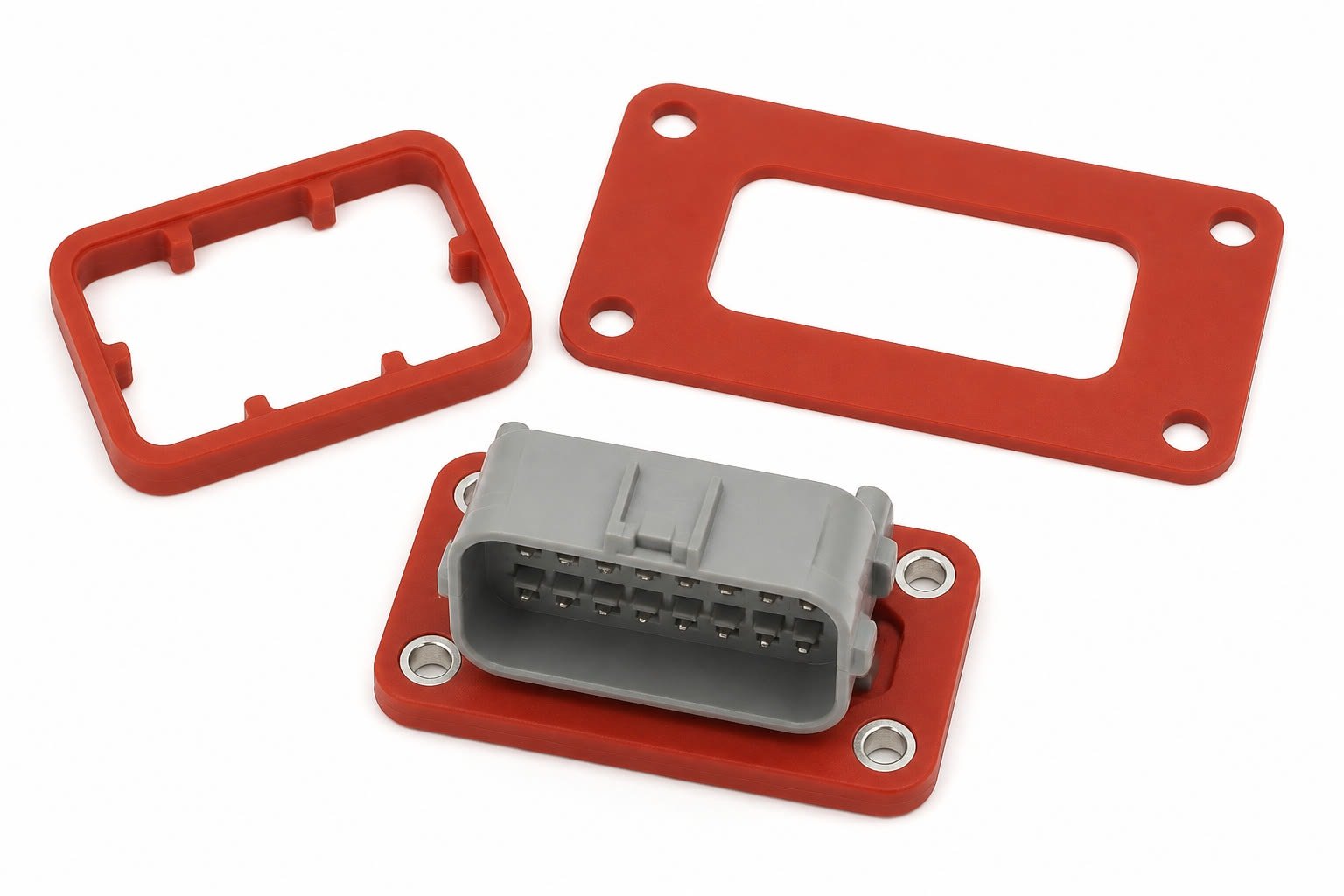
Why Custom Connector Seals Matter
Standard seals often force engineers to compromise on fit, material properties, or assembly efficiency. A custom-molded silicone connector seal ensures:
Exact Fit
Designed specifically for your housing geometry and wire diameters, eliminating gaps that cause ingress.
Optimized Assembly
Custom draft angles, ribs, and low-friction material formulations (or secondary surface treatments) reduce insertion force during wire harness assembly.
Application-Specific Materials
From high-temperature engine compartments to chemical-resistant industrial environments, we match the silicone compound to your performance demands.
Consistent Sealing
Precision tooling and controlled molding processes ensure tight dimensional tolerances for reliable IP67, IP68, or IP69K performance.
Precision Molding Capabilities for Connector Seals
Connector seals—such as wire seals, cavity plugs, peripheral seals, and mat seals—require exacting tolerances. A dimensional deviation of just a fraction of a millimeter can result in a failed leak test.
LSRParts utilizes Liquid Silicone Rubber (LSR) injection molding and precision compression molding to achieve the consistency required for high-volume automotive and electronics production.
LSR Overmolding for Integrated Sealing
When a connector design requires a rigid frame combined with a soft sealing interface, LSR overmolding reduces assembly steps and improves seal integrity. We can chemically or mechanically bond LSR directly to plastic (PA, PBT, PPSU, PEI) or metal substrates (Aluminum, Stainless Steel, Brass), creating a single, robust component.
Plastic Substrates
PC, PA, PBT, PPSU, PPA, PEI etc.
Metal Substrates
Aluminum, Stainless Steel, Brass, Copper
Bonding Strategy
Chemical / mechanical
LSR Injection Molding Specifications
For high-volume, tight-tolerance connector seals, LSR injection molding provides superior repeatability and flash control.
| Parameter | LSRParts Capability |
|---|---|
| Process | Liquid Silicone Rubber Injection Molding |
| Maximum Part Envelope | 300 × 200 × 100 mm |
| Silicone Hardness | 10–80 Shore A |
| Typical Part Tolerance | ±0.05 mm |
| Critical Tolerance | Down to ±0.02 mm, application dependent |
| Mold Manufacturing Tolerance | ±0.01 mm |
| Part-to-Part Repeatability | Approx. ±0.1 mm, geometry dependent |
| Production Mold Life | 3–5 million shots, tooling/application dependent |
| Mold Materials | P20 / H13 / 420 Stainless Steel |
| Production Scale | Prototype → High-volume mass production |
Material Selection for Connector Seals
The operating environment dictates the material. Our engineering team helps you select the right silicone compound to ensure long-term performance under thermal stress, chemical exposure, or mechanical compression.
| Material | Target Applications for Connector Seals |
|---|---|
| General Purpose LSR | Standard electronics enclosures, consumer devices |
| Fluorosilicone (FSR) | Automotive connectors exposed to fuel, oil, and aggressive solvents |
| High-Temperature Silicone | Engine bay connectors, high-power EV terminals |
| Low-Temperature Silicone | Outdoor sensors, aerospace applications |
| Electrically Conductive Silicone | EMI shielding seals for sensitive electronics |
| Flame-Retardant Silicone | Electrical systems requiring UL 94 V-0 compliance |
From DFM to Mass Production: How We Support Your Project
A reliable silicone seal starts before the mold is cut. If a part is designed with excessively thick sections, inadequate draft, or undercuts that trap air, the production run will suffer from high scrap rates and inconsistent dimensions.
When you submit a 3D model or drawing, our engineering team conducts a thorough DFM review. We analyze part geometry, wall thickness, sealing ribs, draft angles, flash requirements, and expected production volume (typically targeting 100,000+ pieces annually).
Fewer Tooling Revisions: Identifying manufacturing risks early prevents costly modifications after T0 sampling.
Faster Time to Market: By streamlining the design for molding, we accelerate the transition from prototype validation to stable production.
Lower Unit Costs: Optimized mold layouts (multi-cavity tooling) and reduced cycle times translate directly to savings in high-volume production.
Our Tooling and Production Workflow
DFM Review & Material Selection
Aligning design with manufacturability.
Mold Design & Tool Manufacturing
Utilizing 3-axis/5-axis CNC and Wire EDM for precision hardened steel tooling (H13, S136, 420).
T0/T1 Sampling
Providing benchmark prototypes (approx. 10–12 days for prototype tools, 3–6 weeks for production tools).
Validation & Production Approval
Ensuring parts meet your leak and insertion force requirements.
Mass Production & Secondary Operations
Scaling up with multi-cavity tooling.
Secondary Operations for Complete Solutions
Connector seals often require additional processing to function correctly within a wire harness assembly. LSRParts provides a full suite of secondary operations in-house:
Post-Curing
Ensuring complete cross-linking and outgassing of volatile compounds for high-temperature stability.
Precision Trimming & Deflashing
Critical for maintaining the integrity of the sealing lip.
Valve Slitting
For mat seals or wire seals requiring self-closing features.
Surface Treatments
Reducing tackiness to lower the insertion force required during automated wire harness assembly.
Inspection & Custom Packaging
Ensuring parts arrive ready for your assembly line.
Start Your Custom Connector Seal Project
If you are an OEM or Tier supplier developing a new connector system, or if you need to transition an existing custom seal into high-volume production, LSRParts provides the engineering support and precision manufacturing required.
Submit your 3D files (SolidWorks/CAD), annual volume requirements (ideal projects are 100,000+ pcs/year), and material specifications for a comprehensive DFM review and quotation.