
Custom Precision Silicone Manufacturing
EV Battery Seals Engineered for the Demands of Electrification
The electric vehicle industry demands uncompromising reliability, safety, and longevity from every component. At the heart of an EV is the battery pack, which requires robust protection against moisture, dust, thermal fluctuations, and chemical exposure. LSRParts specializes in manufacturing high-precision, custom EV battery seals using advanced liquid silicone rubber (LSR) and compression molding technologies.
We partner with automotive OEMs and Tier suppliers to deliver production-ready silicone sealing solutions engineered to meet the stringent performance requirements of the rapidly evolving EV sector.
The Critical Role of EV Battery Seals
EV battery packs are subjected to extreme operating conditions. A failure in sealing can lead to thermal runaway, short circuits, or catastrophic system failure. High-quality EV battery seals ensure:
-
Ingress Protection (IP Rating)
Complete defense against water, moisture, dirt, and road debris.
-
Thermal Management
Resistance to extreme temperature variations, ensuring seal integrity during rapid charging and discharging cycles.
-
Chemical Resistance
Protection against battery coolants, dielectric fluids, and environmental chemicals.
-
Vibration Damping & Flame Retardancy
Absorption of road shocks and vibrations to protect delicate internal electronics, plus critical fire safety for passenger protection.
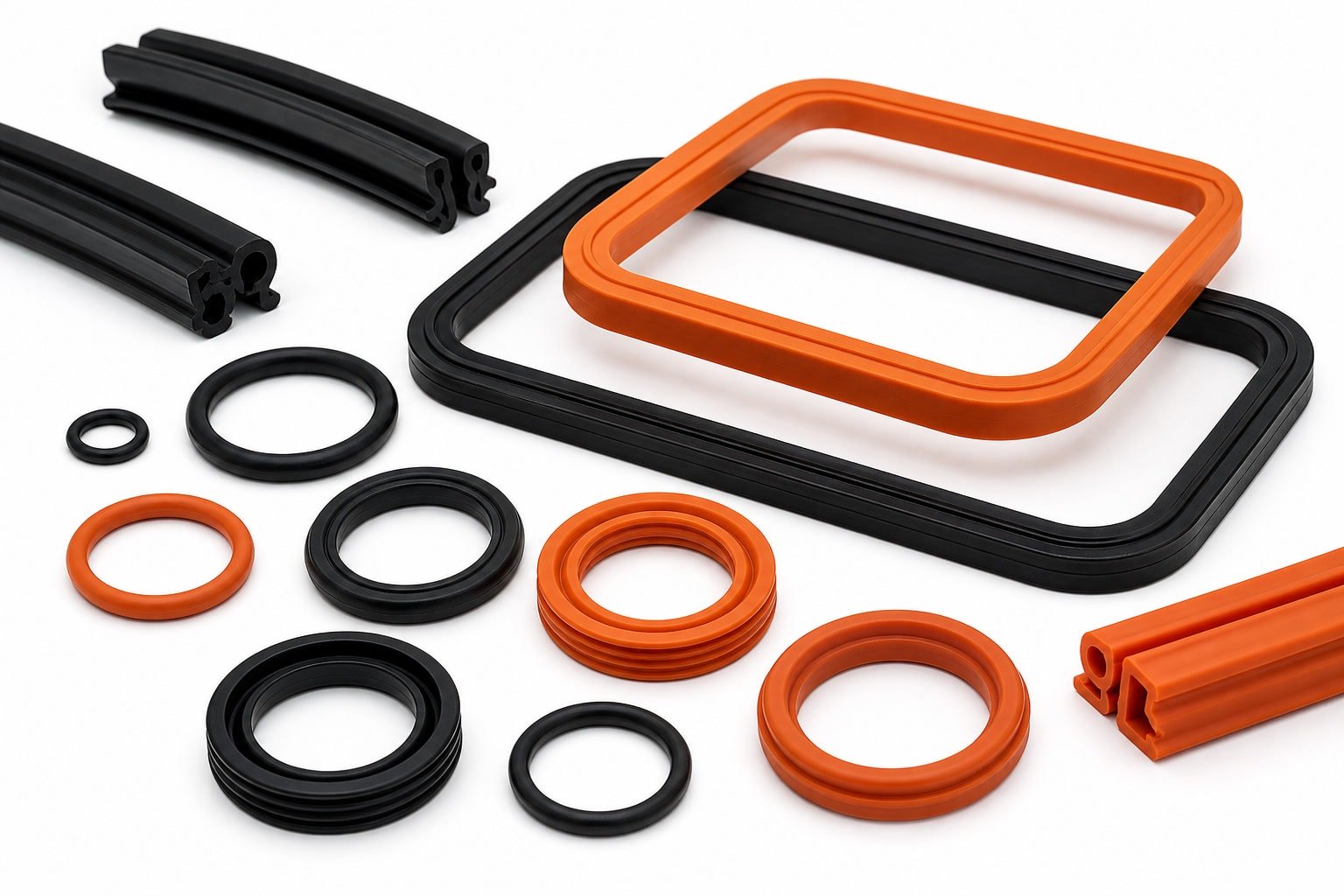
Custom Sealing Solutions for EV Applications
LSRParts does not supply off-the-shelf catalog products. We focus entirely on custom components built around your specific 3D drawings, application needs, and performance criteria.
Battery Pack Enclosure Seals
Large-format perimeter seals ensuring IP67/IP69K protection for the main battery housing.
Cooling System Seals
O-rings and custom gaskets for liquid cooling lines and thermal management systems.
Connector & Wire Seals
Precision LSR seals for high-voltage connectors, wiring harnesses, and charging ports.
Module & Cell Seals
Micro-seals and isolation pads for individual battery cells and modules.
Pressure Relief Valve Seals
Precision diaphragms and seals for battery venting systems.
Advanced Manufacturing Capabilities
Our manufacturing facility is equipped to handle everything from intricate high-voltage connector seals to large battery enclosure gaskets.
Liquid Silicone Rubber (LSR) Injection Molding
For high-precision, high-volume EV battery seals, our LSR injection molding process delivers exceptional dimensional consistency and part-to-part repeatability.
- Tolerance ±0.05 mm typical, down to ±0.02 mm
- Hardness 10–80 Shore A
- Efficiency Automated high-volume molding
- Tooling P20, H13, 420 Stainless — 3–5M shots
LSR Overmolding
To simplify assembly and improve seal integrity, we offer LSR overmolding onto plastic (PC, PA, PBT, PPSU) or metal (Aluminum, Stainless Steel, Brass) substrates. This is highly effective for creating integrated battery covers, busbar insulators, and rigid-to-flexible connector housings.
Compression Molding
For large EV battery pack perimeter seals, our compression molding capabilities can accommodate massive part envelopes up to 2500 × 2000 × 1000 mm, providing robust and cost-effective solutions for large-scale gaskets.
Precision Silicone Extrusion
We manufacture custom extruded silicone profiles, cords, and tubing used for continuous perimeter sealing and cooling line applications.
High-Performance Silicone Materials for EVs
Selecting the right material is critical for EV battery seals. During our DFM and material selection phase, we match the compound to your specific environmental and regulatory requirements.
Available materials are selected based on your application's thermal, chemical, and mechanical demands, ensuring optimal performance and regulatory compliance.
Flame-Retardant Silicone
Essential for battery enclosures to meet UL94 V-0 standards and enhance thermal runaway protection.
Thermally Conductive Silicone
Used for thermal interface materials (TIMs) and seals that aid in heat dissipation.
Fluorosilicone
Provides exceptional resistance to harsh automotive fluids, coolants, and oils.
High/Low-Temperature Silicone
Maintains flexibility and sealing force in extreme climates and operating temperatures.
Electrically Conductive Silicone
Utilized for EMI/RFI shielding applications within the battery management system (BMS).
From Prototype to Mass Production: The LSRParts Workflow
A reliable EV battery seal starts long before the mold is cut. We support automotive engineering teams through a rigorous, production-focused workflow.
DFM Review
We analyze your part geometry, wall thickness, draft, flash requirements, and expected production volume. We identify manufacturing risks early to ensure a stable path to mass production.
Material Selection
Recommending the optimal silicone grade for thermal, chemical, and mechanical performance.
Mold Design & Tool Manufacturing
Utilizing in-house CNC and EDM capabilities to create precision prototype (Aluminum) or production (Hardened Steel) tooling.
T0/T1 Sampling & Validation
Providing initial samples for fit, form, and function testing.
Mass Production
Scaling up to high-volume manufacturing with strict quality control.
Secondary Operations
Offering post-curing, precision trimming, die cutting, bonding, and automated inspection.
Why Partner with LSRParts?
LSRParts is dedicated to high-value, repeat-production silicone components. We are the ideal manufacturing partner for automotive OEMs and Tier suppliers who require:
-
✓
High-Volume Capacity
Specializing in programs with annual demands exceeding 100,000 pieces.
-
✓
Precision Engineering
Capable of meeting the strict tolerances required for high-voltage and critical safety applications.
-
✓
Comprehensive Support
End-to-end service from initial CAD review and mold flow analysis to final assembly and custom packaging.
-
✓
Quality Assurance
Rigorous inspection protocols to ensure every seal meets the demanding standards of the EV industry.
Request a DFM Review
Contact LSRParts today to discuss your EV battery seal requirements, submit your 3D CAD files for a comprehensive DFM review, and secure a reliable manufacturing partner for your next-generation electric vehicle platform.